Microsoft’s Common Data Service (CDS) is an Azure-based application which stores and manages the data that is used to create applications on PowerApps and explore insights on Power BI.
CDS is the collective name for two different services offered by Microsoft, CDS for Apps and CDS for analytics.
The former is built into PowerApps and it brings together and stores the data from Dynamics 365 applications and databases to enable users to create business applications.
The latter, on the other hand, is similar to a data warehouse or data lake. It pulls, aggregates, cleans, integrates and stores data from multiple sources which can then be used by organisations for analysis to produce visualisations, dashboards and reports.
Using CDS has a number of benefits, including:
Effortless data management: the data is stored in the cloud, so users can benefit from the lower costs associated with cloud storage, scalability. data redundancy and high availability.
Security: role-based access allows organisations to easily control who has access to the data
Dynamics 365 integration: users can easily utilise data on Dynamics 365 to create business applications
Data quality: business rules, workflows and process flows are used to ensure the quality of the data that is stored.
Common Data Model (CDM)
When using multiple sources to create
business applications or explore business data, each source may have a specific
way in which it categories, formats and structures the data. In order to aid
the development of business applications and data analysis, CDS uses the Common
Data Model to create standardisation and consistency across the data. The CDM
is shared data language that allows different business applications and
databases to communicate in the same language, so to speak.
The CDM contains a set of standardised schemas and semantic metadata that creates a standardised structure and format for data coming from different sources. It does this through the set of entities that standard across businesses, as well as the relationships between these entities. Entities are a set of individual data records.
Think of entities as tables within a database and records as specific rows within those tables. It is common for entities to share the same data and thus have a relationship.
For example, the entity “Discount” will likely share data with “Quote”, since businesses will quote a discounted price to attract customers. If a business requires an uncommon, specific entity they have the option of creating their own. Some of the standard entities included in the CDM are listed below.
Microsoft Teams is a
communications tool that enables the growth of interaction and collaboration by
enabling text and video chat between team members. In teams, users can
participate in group chat room threads, send and receive instant private
messages and video call with two or more users. However, Team is more than just
a messaging tool, uses can also view, edit and share documents on OneDrive
without leaving the application. Users with Enterprise, Business Essentials or
Business premium can access Teams.
Team is available through an
internet browser, desktop application and mobile app.
It is possible to use to use
teams externally as well as internally. Meetings can be set up and held with
people who are external to a company, simply by sending through Team Meeting
link. Attendees can then connect to the meeting through whichever device they
prefer, or can call in from a phone (in which case there won’t be any option
for video).
Native integration with Microsoft
Office services include Word and Excel, but also SharePoint, OneNote,
PowerPoint, Planner, Power BI, Delve and cloud storage. Among the benefits of
the latter is that all team members can view the latest version of data, as
content is synced and stored instantly. This can allow members of a team to
instantly view and collaborate on documents together – this can also be done
whilst on a Team meeting call.
Key benefits of Teams:
One centralised hub
Office 365 integration
Customise Teams through APIs and bot frameworks
Enterprise security & compliance
Azure Active Directory integration
No extra cost to Office 365 users
It was announced that from
October 2019, Teams would absorb the capabilities of StaffHub, which will be
discontinued. StaffHub is a scheduling and work planning application which
helps organisations with the onboarding of new staff, deliver training and
assign tasks.
Yammer
Yammer is an enterprise social
network which allows social networking and communication within organisations.
It present a less-formal alternative to email communication, and it creates a
space for engagement where employees can respond to the announcements made by
management.
Whereas Teams is used for instant
messaging in relatively small teams, Yammer can be used for engaging with
organisations or departments as a whole. Yammer can be used to send out task
reminders, announce recent successes or changes to the business, praise
employees and introduce new joiners, for example. Another key feature is that
external individuals can be added to the organisation’s Yammer, aiding greater
collaboration and engagement with external stakeholders.
Yammer can be described as an
organic knowledge repository of information and idea sharing. It’s not uncommon
for people to send emails (this is how we traditionally conducted business) but
it is also not uncommon for things to get lost in email.
Skype for Business
Skype for Business is a
communications enterprise software that can be used on the cloud, known as
Skype for Business Online, or on premise, known as Skype for Business Server.
It enables users to communicate via instant messaging, as well as audio and
video calling.
In September 2017, Microsoft
announced that Skype for Business would be replaced by Teams.
The Microsoft Power Platform is a
system of applications which work together to enable users, from managers to
employees, to have a positive impact on the business and its customers. There
are three parts to the system: Power BI, Flow and PowerApps. Although each
application can be used individually, it is the combination of all three which produces
the greatest benefit for organisations.
Power BI
Power BI is a business
intelligence software which allows users to analyse and visualise data to
produce useful and actionable business insights without the need for technical
skills. Data can be imported into Power BI from a number of different sources,
such as excel spreadsheets and on premise or cloud-based datacentres. Power BI
can be used on the desktop application called Power BI Desktop, the online
software-as-a-service application called the Power BI Service, or through the
mobile application.
There several central components
of Power BI: Power Query, Power Pivot, Power View, Power Map, Power BI Service
and Power BI Q&A.
Power Query
Power Query is used to extract,
clean and transform data from a range of different sources, such as databases
including SQL Server and MySQL, files such as Excel, JSON and CSV, and other
applications such as Azure and Outlook.
Power Pivot
Power Pivot is a data modelling
tool which allows users to create data models where data is structured in a way
to show the inter-relationships and hierarchies between different data
elements. For example, if two different datasets contain common data in their
columns, users can use Power Pivot to easily create relationships between the
two datasets by using the drag and drop feature.
Power View
Power View is the main data visualisation
tool within Power BI and it allows users to create interactive data
visualisation in a number of different formats, such as graphs, charts and
treemaps. Users can use slicers to slice and dice the data to explore insights
in greater detail.
Power Map
Power Map is an interactive data
visualisation tool that enables users to discover and explore insights in 3D which
may not have been possible with 2D charts and tables. Due to its integration
with Bing, users can explore the data broken down by geographical location.
Power BI Service
Power BI Service is a component
which allows users to keep up-to-date with information about their
organisation. A central feature of Power BI Service is that users can share
dashboards which present insights through interactive data visualisations.
Dashboards are made up of tiles, with each tile showing a different data
visualisation. Tiles pull data from on premise and cloud-based datasets as
their source and will update as the data changes.
Power Q&A
Power Q&A is a natural
language tool for asking questions about data in English, rather than in a
programming language. Users can ask questions about the data model they have
built and imported into Power BI and receive answers quickly and easily. This
feature allows users to explore insights that they may not have discovered
otherwise.
For example, if the data contains
a number of columns with the titles “region”, “quarter” and “sales”, a user can
type the following question into Q&A: “sales by region in the last quarter
as a bar chart”, and Q&A will produce a bar chart showing that information.
If users do not specify which type of visualisation they want the data to be
presented in, Q&A will choose the best type based on the data. Q&A also
includes keywords contained in the dataset to help uses ask meaningful
questions about the data. Another way in which Q&A helps uses is that it
comes with an auto-complete feature, which predicts the question the user is
going to ask.
Flow
Microsoft Flow is a cloud-based
software that allows users automate tasks between applications without the need
for any technical skills. To do this, users create workflows, known as flows,
by specifying the action that should occur when an event happens. Flow can be
used to automate a vast number to different tasks, using applications within
the Microsoft Suite, such as Dynamics 365, Office 365, and applications outside
of the Suite, such as Dropbox, SQL Server, Twitter, Salesforce and GitHub.
Benefits include:
Streamline day to day tasks
Easily share and access business data
Collaborate on a common platform
Improve workforce productivity
One way in which Flow can be used
is to automate the process of sending an email after an event has occurred. For
example, when the status of a lead is updated on Microsoft Dynamics, a flow can
be created to automate an email to be sent around specifying the details of the
update to the appropriate staff. Although users are free to create their own
flows, the application contains an extensive range of flow templates, allowing
users to quickly choose the flows they need to automate processes.
It is also possible to build
connectors to systems, such as bespoke-developed applications.
PowerApps
PowerApps is a platform-as-a-service
application development software in which users can create and share mobile
apps for business use that run on a variety of operating systems, such as iOS,
Android, Windows and most internet browsers. Rather than having to develop an
app for each OS individually, the apps users create run on the PowerApps app. This
cuts down the time and cost involved in development drastically.
The aim of PowerApps is to enable
users to create business solutions without the need of technical expertise. It
does this by presenting an intuitive, user-friendly interface in which users to
utilise drag and drop functionality to create apps. Although PowerApps does require
the use of formulas, these formulas are based on those used in Excel to
optimise ease of use. The key benefit of this is that it makes solving business
issues accessible to those who would not necessarily have been involved in a
traditionally technical task, bringing new ideas that add value to the
business.
Much like Flow, PowerApps can be
used with a number of different applications, such as Dynamics 365, SQl Server,
SAP, Oracle and Dropbox.
There are two methods for
creating PowerApps:
Canvas Driven
Model Driven
Canvas Apps is a visual canvas to
help you design and build apps – the aim is to provide a comfortable
environment to create what is needed. Rather than using complicated coding or
programming tools, users can drag and drop various elements into the canvas
from whatever is required. Throughout, it’s possible to format the right
conditions and settings that are needed to make the application work. Existing
data sources can be integrated natively without any issues.
Model apps can run as either a
standalone or as the backend to a canvas app. One of the core benefits of
Model-driven apps is their ability to generate data models. When inputted, the
data is defined as a structure which allows the app to conform to your
information. Similarly, developing an application utilises consistent business
processed. Once this is all finished, the app designer would then be used to
develop the final product. No matter how complex or easy, what matters are the
steps that provide the basis for its completion. The simple application
architecture allows the app to be customised, without creating new code.
Microsoft has a several different
file storage and collaboration solutions which can be deployed within
organisations to allow sharing, interaction and collaboration between
employees.
SharePoint Online
SharePoint Online is Microsoft’s
cloud-based tool which is designed to foster an environment of sharing and
collaboration within organisations. One of the primary ways organisations use
SharePoint is to manage and share resources within organisations by storing
them on the cloud. Rather than storing documents in a single location, storing
resources on the cloud allows users to access documents from any device, and interact
and collaborate with others across the organisation.
Organisations can also use
SharePoint as an enterprise content management system, in that it can be useful
as a means to efficiently store and organising data and information on a system
that can be accessed by the internet. However, there are also many other ways
in which organisations can deploy and use SharePoint, such as the creation and
management of websites, customer relationship management, networking facilitation,
business intelligence and workflow management.
Organisations wishing to maintain
control over their data and have a greater ability to customise SharePoint to
meet their needs can deploy SharePoint Server, which is installed on premise. This
may be preferable for organisations that hold sensitive and classified data.
Some uses of Sharepoint are:
Intranet Portals,
Document & File Management,
Social Networks,
Websites,
Extranets,
Advanced Search Functionality
Increased Business Intelligence solutions
Collaboration abilities allow
more than one team member to access, edit, and annotate a document
simultaneously. Team members can collaborate to formulate the document by
breaking down tasks or sections, and SharePoint will cohesively stitch together
a complete document on the fly as they work.
It’s also possible to use
Sharepoint as a document storage repository when using other Microsoft
applications, such as Dynamics365. There is seamless integration between these
products, and implementations of this can have major benefits in terms of
storage pricing (Sharepoint storage is somewhat of a fraction of the cost of
Dynamics storage – the benefits of this are seen when implementing solutions
that will need to scale up over time). It can be used for attachments, emails,
etc
OneDrive for Business
OneDrive is Microsoft’s cloud
storage service that allows users to store files and access them from anywhere
on any device. Due to its integration with Office 365, OneDrive enables users
create and edit documents on the cloud, and share these documents to
collaborate with others. Local copies of documents can be downloaded from the
cloud to view and edit offline (with then synchronising back online when
re-connected). The service can be used for both personal and business/school
use, but the latter service is managed internally in the organisation and is referred
to as OneDrive for Business.
Following on from the information
for Sharepoint above, OneDrive for Business with Dynamics 365 is a great way to
expand on SharePoint integration by allowing users to associate documents to
SharePoint-enabled entities from their own OneDrive for Business folders. This
does need Sharepoint to already be in place and integrated with Dynamics365 in
order to work
Delve
Microsoft Delve is a cloud-based
solution powered by Office Graph, which is a repository of user content and
activity, and the inter-relationships between them. Essentially, Delve provides
users with up to date information on what they are currently working on and who
they are working with, and helps increase interaction and collaboration between
employees within organisations.
The purpose of Delve is generally
to be able to present in front of us what we need before we even ask for it. An
example of this could be an upcoming meeting – Delve should be able to show you
the related documents for the meeting (subject to security controls – if you
don’t have security access to view the files, they won’t be displayed)
On Delve, all users can create
and update their Office 365 profile with their professional interests, current
projects, skills and certifications. Users also receive a personalised home
page, which enables them to discover important information from across the
Office 365 Suite, such as emails, events, contacts and documents. The home page
provides users with links to their recently accessed documents, other user’s
profiles and a content feed. This content feed uses machine learning and
artificial intelligence which tracks user activity and interaction to present
content that may be of interest to the user.
Visio is a piece of software which enables users to create a variety of different both 2D and 3D diagrams, and is designed to make this process as easy and intuitive as possible. Visio can be used to create any sort of diagrams users need, from simple organisation charts to more complex process maps with multiple swim lanes and decision points.
Other examples of the kinds of diagrams that can be created include building and office plans, timelines, Gantt charts and brainstorming diagrams.
General benefits include:
Easy access to shapes and stencils, and a new
status bar that helps you move more efficiently within and between your
diagrams.
Add and align shapes easily and accurately with
features such as the Quick Shapes Mini Toolbar, enhanced dynamic grid,
automatic layout adjustment, and page Auto Size.
Simplify large and complex diagrams using
Sub-processes and Containers to group related shapes visually and logically.
Check diagrams against business rules and logic
to ensure accuracy and consistency in diagrams. With a one click, you can
validate a diagram to make sure if it’s logical and property constructed.
Create and monitor SharePoint workflows more
easily than ever with a new advanced template that contains SharePoint workflow
rules and logic.
To build these diagrams, users can either select one of the
pre-built templates, customising it as they wish, or they can start from
scratch and use some of the several hundred shapes that are available. If users
cannot find the templates or shapes they required, they have the option of
downloading more templates from the internet or creating and importing their own
shapes. Users also have the option of importing data and information from other
application in Microsoft Office, such as Excel and Access.
Visio is available through the
cloud and on premises. For cloud usage, users have two plan options, named
Visio Online Plan 1 and Plan 2. The former is a better option for those wanting
to create simple diagrams, whereas the latter is more suited for the creation
of professional diagrams with data integration. Included in Plan 2 is access to
the on premises application, whereas Plan 1 is cloud-only.
For using Visio on premise, two
different licenses can be purchased: Standard and Professional. The Standard
license has basic functionality and enables users to create and share diagrams.
The Professional license, on the other hand, enables users to do much more.
Multiple users can collaborate on the same diagram simultaneously and diagrams
can be linked to data, with the diagrams updating automatically as the data
changes. Professional users also have access to more templates. The
Professional license comes as part of an Office 365 subscription.
Project is a project management software that is
available through the cloud, known as Project Online, and on premises, known as
Project Server. It enables project managers to plan and organise projects,
assign and schedule tasks, track and monitor progress, manage budgets, analyse
workloads and generate reports. Project comes with pre-built templates of a
range of project management documentation, which reduces the time wasted on
starting these documents from scratch and allows users to focus their efforts
on more valuable tasks.
It is also possible to build custom templates to suit
specific project types, or that could be used across multiple projects.
Project has a range of functionality that users can
utilise. For example, users can easily track the availability of resources that
an organisation has at its disposal. Each resource within an organisation is
given a calendar that lists its availability and Project is able to schedule
tasks based on these calendars.
Some of the main functionalities are:
Planning & Scheduling
Project Timeline View
Collaboration
Reporting
Resource Management
Multiple Projects
Different Views
An additional bonus is in dealing with ‘What If’
scenarios. It’s common to be asked how timelines can be changed (usually to
bring them forward) – Project allows you to easily go back and modify the criteria
(eg resource availability, parallel-pathing of tasks, etc) to see if a more
appealing scenario could be an option.
Project Online, the cloud-based solution, is available
on a per-user monthly subscription plan with the options for the Essentials,
Professional and Premium packages. It also integrates natively with Office365,
for seamless working. This allows the various Office365 applications to be
included and utilised for their functionality
Project Server comes in two versions, Standard and
Professional, and is available for an upfront fee.
Planner
Microsoft Planner is a project management solution
which allows has a range of functionality to assist project managers in their
role, for example creating plans, scheduling and distributing work, tracking
progress and managing time. Using Planner enables project teams to easily share
their documents to the whole by uploading them to a central repository, which
allows organisations to increase collaboration, transparency, coordination and
team working.
Much like the other applications in the Microsoft
family, users benefit from Planner’s close integration with other Office 365
applications, such as Outlook, SharePoint and Teams.
Planner uses task cards arranged into columns, with a set of columns forming a ‘board’ for a project. This allows the tasks to be viewed visually at a high level, being able to easily see how/where they are included in the project.
A common use for Planner is in Incident Management.
For example, there could be columns for New Issue, Evaluating, In Progress,
Closed. Tasks raised would be progressed through the different stages, and
would be allocated to an individual to take control of.
Planner is available on the following Office 365
subscriptions: Enterprise (E1, E3 and E5), Education, Business Essentials and
Business Premium. It is not available for personal use.
Microsoft PowerPoint is a program which offers users the ability to create presentations to display information. PowerPoint come with a wide range of templates for a number of different kinds of documents which can be used to customise the way in which information is presented on the slides. This allows staff to focus their time on the information and data rather than on formatting.
PowerPoint has been the
traditional presentation software in the Microsoft Stack for a number of years,
and is considered to be ‘Business Standard’ in many organisations.
Presentations can be created using a wide range of options, utilising media such as images, GIF’s, tables/charts, audio, videos, etc. Different viewing effects are also available, to create a richer display for viewers to gain further information from.
Presenters can keep track of
their notes, which are only visible on the device that the presentation is
being displayed from; viewers of the presentation cannot see these.
Using Office365 through a
browser, presentations can be created, edited, viewed and shared. It’s also
possible to have collaboration on a presentation by multiple people in
‘real-time’
PowerPoint can be used in a
number of different effective ways to communicate with your audience. Slides
are completely customizable to fit your needs. Depending on your approach, you
may want to have a presentation that is text-heavy, image-heavy or some
combination of both. Text-heavy presentations are generally good if you are
giving a lecture to a group within your company and want them to take notes.
Image-heavy presentations can help to make your presentation more
conversational in style since there only visual cues. Combining the two
approaches gives listeners the benefits of both visual aids and notes.
Sway
Although PowerPoint is normally
the go-to application for producing presentations, Microsoft has another
application which is focused towards enabling users to easily create more
engaging presentations, with an emphasis on telling a story rather than
presenting a topic.
Sway is a presentation software which enables users to create a range of different documents, such as newsletters, business presentations, portfolios and reports. Although Sway and PowerPoint have many of the same functionalities and capabilities, Sway is Microsoft’s attempt to provide users with a more user-friendly application that focuses on creating content that will engage audiences through telling a story. The emphasis on telling a story rather than creating a presentation means that Sway guides users to create a storyline and narrative, rather than individual, segmented slides of a presentation.
Sway comes with a number of
in-built templates to help begin the process of creating presentations, or ‘Sways’.
This enables users with non-design backgrounds to easily create Sways that are
both visually striking and engaging. If users cannot find a template to start
with, they have the option of searching a topic and Sway will produce an
outline of a Sway based on this topic for them to use.
It helps gather, format, and
share reports, newsletters, web pages, and presentations on an interactive,
web-based canvas that that presents well on almost any screen. The
collaboration allows you to invite others to be able to edit the story as well
in ‘real-time’. It’s also possible to include videos (eg YouTube) and other
content from external sources.
Sway is exclusively cloud-based
and a free version is available to all users with an Outlook account. An
upgraded version is also available in most Office 365 subscriptions for Home
and Business.
Presentations can be published to
external (public-facing) websites, and include analytics that will show you how
many people have viewed it
Microsoft Office 365 is a
software-as-a-service which allows access to a suite of applications through a
subscription-based model. Office 365 can be used for both home and business
use, and is available on premises and through the cloud (note that some of the
extended functionality is only available through desktop applications; access
to these will depend on the level of license purchased).
Word
Word is a word processing application which is used to create, edit and format written documents for both home and business use, and it is available in every subscription level across the Office 365 platform. It can also be purchased separately outside of a subscription.
Word has wide applications in the business world as it can be used to create any sort of business document, such as proposals, reports, plans and memos. Templates for these documents can be found in both Word itself as well as online, allowing users to create their documents without having to waste time formatting documents. Also, due to the range of design options available in these templates, users can choose templates which fit the culture of the organisation.
With collaboration, it is
possible for multiple people to be viewing and editing a single document at the
same time.
Excel
Excel is a widely-used
spreadsheet software that allows users to calculate, analyse and visualise
data. Like Word, it is part of the core applications suite and is available as
part of every subscription package for both home and business use. It can also
be purchased separately.
At the most basic level, Excel
can be used for entering and storing data. The program, however, has far more
capabilities than this, and contains around 500 functions to carry out a vast
amount of different tasks, ranging significantly in complexity. The functions
available range from simple, everyday functions such as sum, average and count,
to more complex and specific functions such as the ACCRINTM function which
calculates the interest accrued on a security which only pays interest at
maturity. Due the vast capabilities of the program through the functions
available, Excel has wide application in the business world and can be a
powerful tool for organisations.
Excel also has the ability to use
the data within it to create graphs, charts, pivot-tables and other items. This
allows for data to be able to be presented visually, enabling people to quickly
see an overall picture of the data.
It’s also possible to connect
Excel to other data sources (either as a once-off, or with a continual link).
This can allow data held elsewhere (e.g. Dynamics365) to be manipulated further
within Excel itself. Examples of scenarios for this include comparing and
utilising multiple data sources to create an overall dataset.
With collaboration, it is
possible for multiple people to be viewing and editing a single spreadsheet at
the same time.
PowerPoint
Microsoft PowerPoint is a program
which offers users the ability to create presentations to display information.
PowerPoint come with a wide range of templates for a number of different kinds
of documents which can be used to customise the way in which information is
presented on the slides. This allows staff to focus their time on the
information and data rather than on formatting.
Further information can be found
in the documentation for ‘Microsoft Presentations’
OneNote
OneNote is a notebook software
which enables users to capture ideas, take notes and create task lists. Notes
can be created using text, audio recordings, videos and highlighting and
annotating text. Users can organise their notes into pages and sections and
notebooks, and can easily share their work with others.
Benefits of OneNote include:
Taking notes & gathering information on any
device.
Synced on all devices for anytime access to
notes.
Create notebook sections inside books.
Create notebook sections inside notebooks
Create pages & subpages inside sections
Handling mathematical formulae natively
OneNote is also optimised for
touchscreen and tablets, allowing users to enter data directly without using a
keyboard. Benefits of this include being able to draw diagrams directly into
documents, placing flow diagrams easily, etc.
It’s also possible to directly
implant other files that can then be referenced, such as saving images from the
web, articles from news-sites, and other items.
Access
Access is a database software
which allows users to collect, store, sort and manipulate databases. Access and
Excel are similar in that they both store data in columns and rows, and can carry
out similar tasks, but there are important differences between the two
applications and how they are used by organisations. Access is more focused
towards for working with databases, and as a result it has a much greater
storage capacity than Excel, which is not designed for storing large amounts of
data. It is also preferable to use Access to handle large amounts of records,
for example, as the manipulation of the data is more productive and it can ensure
consistency and accuracy.
When looking at implementing
database systems, it could also be useful to consider using Microsoft SQL
Server as the database layer for large/complex solutions.
Access is available in the more
premium subscriptions for home and office use. Alternatively, it can be
purchased separately outside of a subscription.
Publisher
Publisher is a publishing
application (only accessible through a desktop application, not as a hosted
product) that comes with the more enterprise Office365 licenses, or as a
stand-alone application. Publisher differs from Word, which is Microsoft’s
flagship word processing application. Word is for writing documents, whether
they be long or short with the tools to add page numbering, footnotes, tables
of content, indexes, references and annotation. Publishing on the other hand
specialises in creating newsletters, brochures, and greeting cards that have
graphically rich content and require precise positioning of text and graphics.
Publisher comes with many
templates specifically designed for most printed media with pre-positioned
placeholders for text and graphics. This makes it easy to choose the layout
that best suits the application, for example a newsletter and then start adding
text and graphics to suit.
Everything that Publisher does is
about creating an aesthetically pleasing layout, formatting and the control
that the designer has over objects on a page. Images and even blocks of text
are all elements to Publisher and they can be positioned anywhere on the page.
Additionally, all these elements are independent of one another. Changes to one
element’s position, colour or size doesn’t affect any other element.
Outlook is a communication and
information management software that allows users to connect and organise their
email accounts, address book, calendars and task list. Although Outlook is
mainly used for its email functionality, users can also enter appointments and
events on the calendar application, add contact information in the address book
and create lists of tasks to carry out.
It is possible to be able to
connect to different types of email account (Exchange, Office365, POP3, IMAP etc).
Different functionalities within Outlook will depend on the account and
integration type (eg the Outlook Calendar will not synchronise back to a cloud
provider if connecting to it through POP3). However there are various
third-party add-ons that can provide and extend the functionality to accounts
and devices
Outlook is available for both personal and business use across the Microsoft Office suite in every level of subscription offered. It can be accessed through the Outlook desktop application, or the Outlook web interface
Mail
Mail, the email component of Outlook allows users to send and receive emails, create folders and set filters to sort incoming emails into these folders, send emails at a future date, edit and manage rules for specific events and use conditional formatting.
It’s possible to flag emails
visually with different colours, or to mark them as a Task (which will then
appear in the Task list).
Using Rules, workflows can be set
up to auto-route emails to specific folders based on the sender, subject, etc.
This can assist with de-cluttering the general Inbox for users, allowing them
to be more efficient. It’s also possible to set up more complicated workflows
(eg auto-responders) quite easily
Calendar
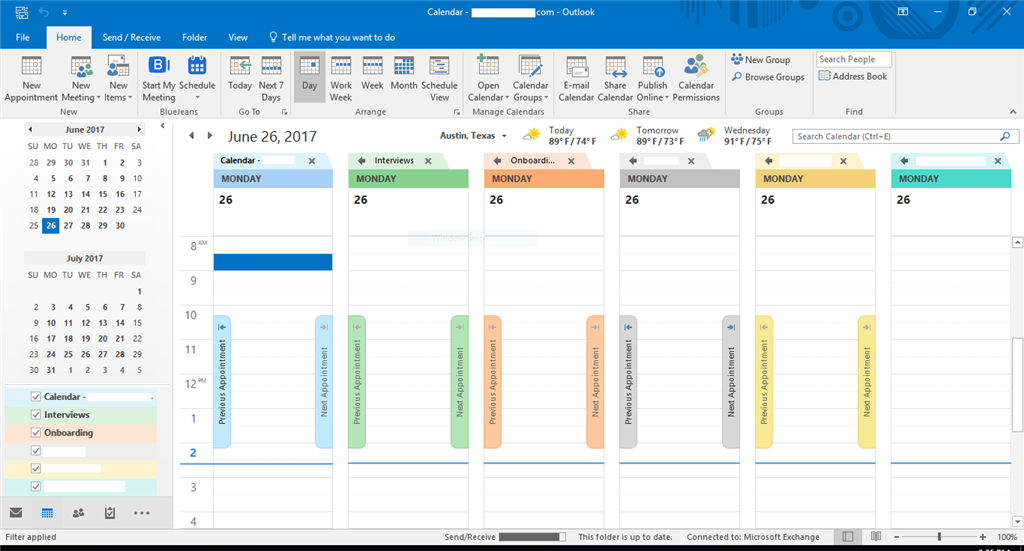
The calendar component within Outlook can be used to create, edit and search for appointments and reminders, track RSVPs, manage multiple calendars, share your calendar with specific people and use the scheduling assistant to check whether attendees are free on certain dates.
There is the ability to be able
to delegate control of a calendar to other people, with varying degrees of
access. This can allow someone else to manage the calendar on behalf of the
user, as well as arrange meetings for them.
Appointments can be scheduled
with both internal company contacts, as well as external contacts.
Outlook lets users schedule
resources like meeting rooms, projectors, etc simply by adding them as a
resource to a meeting. The resource then functions just like any attendee,
including the ability to auto-respond to the meeting invite as well as the
ability to see the free/busy schedule.
People
The contacts part of Outlook, known as People, allows users to create, edit and search for contacts, place contacts into folders, and link contact accounts to Twitter and LinkedIn. Users of People can also import their contacts from friends, followers and connections on Facebook, Twitter and LinkedIn.
When using Exchange, the People
section of Outlook can be used to import information for other company users
and/or contacts from the Exchange Global Address Book.
Tasks
In the task manager component of Outlook, users can create, manage and organise the tasks that need to be undertaken as part of a project. Tasks allows users to create tasks, share and assign them to others, prioritise and categorise them, track tasks by time and monitor their status and progress, amongst other things.